


Manjushri Gilt-Bronze, Yongle Period Ming
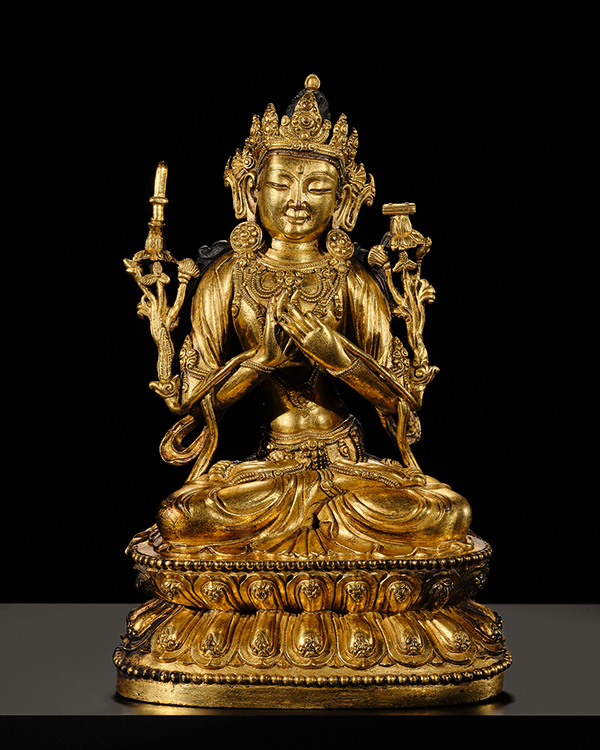
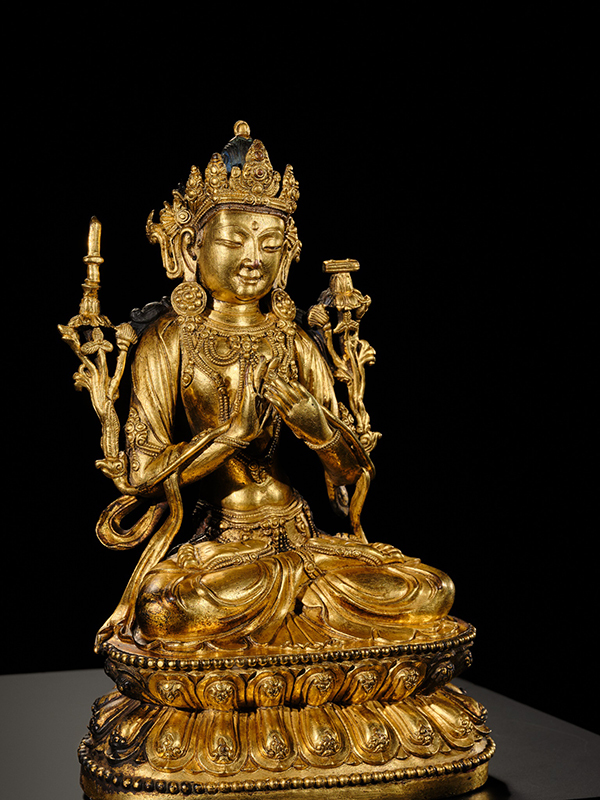
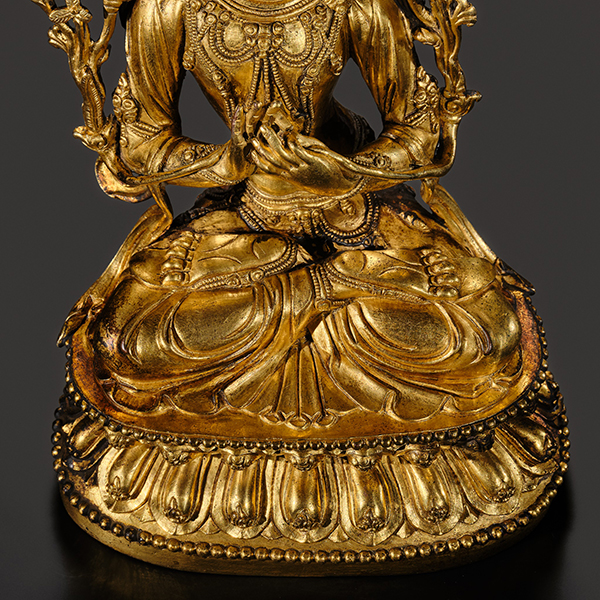
Manjushri Gilt-Bronze, Yongle Period Ming. The bodhisattva is finely cast seated in dhyanasana upon a double-lotus base, the hands held in dharmachakra mudra while delicately grasping the tips of lotus stems rising to blossom at the shoulders and supporting his attributes, a sword and a book. He wears a flowing dhoti, gathered in soft folds around the knees, and a sash draped over the shoulders leaving the chest bare, adorned with beaded pendant jewelry.
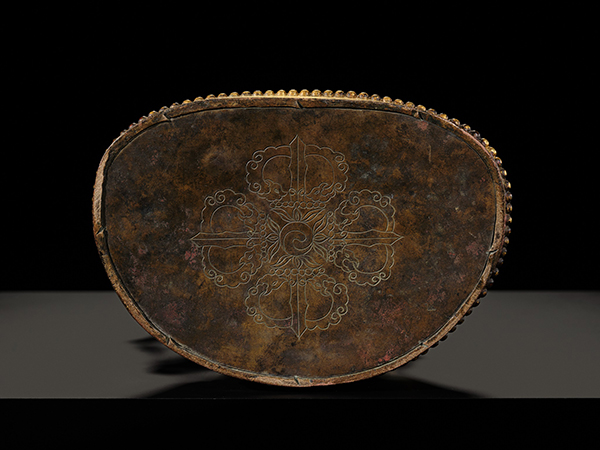
The face is sensitively modeled with a composed expression, defined by heavy-lidded downcast eyes and gently pursed lips forming a subtle smile. The hair is arranged in braided strands drawn back into a chignon, with loose tresses falling over the shoulders, and surmounted by a five-leaf tiara. The base is sealed with a copper plate, finely incised with a double vajra.
Such finely preserved gilt-bronze figures from the Yongle period remain among the most sought-after works of early Ming Buddhist sculpture.
Provenance: A private collection in Turin, Italy, and thence by descent
Condition: Very good condition with expected wear and minor casting irregularities, including small areas of pitting, shallow cast recesses, and slight warping. There are light surface scratches, tiny nicks and losses, and minor rubbing to the gilding. Remnants of an ancient lacquer coating remain, together with traces of old varnish and pigments. The sealing is original, and the seal plate retains faint remnants of red lacquer, as is typical for this corpus.
Conservation: At the time this sculpture was acquired by Becker Antiques, the surface retained substantial remnants of old lacquer gilding. On the front-facing areas, however, the lacquer was already heavily worn, with evident flaking, areas of loss, and clear traces of handling and accumulated soiling. A limited, strictly conservative cleaning was therefore undertaken on these areas, with the sole aim of removing surface accretions and allowing the underlying fire gilding and sculptural detail to read more clearly. The reverse, base, and remaining areas were deliberately left untouched in order to preserve the lacquer layer applied over the original gilding. As observed repeatedly within this corpus, such lacquer coatings are generally understood to have been added at a later date — most often in the 16th or 17th century — and do not form part of the original production from the early 15th century.
Weight: 2,927 g
Dimensions: Height 23.5 cm
This image is representative of a group of Buddhist figures made in China during the first half of the fifteenth century that displays a style influenced by the art of Tibet. In the preceding century under the Yuan Dynasty, the authority of Mongol rulers had become closely associated with Tibetan Buddhist or Lamaist rituals. The tradition of Lamaist art continued into the Ming period and prevailed in works of art such as the present example. Missions to Tibet were sent during the early part of the Ming dynasty and sought to maintain good relations with the Tibetan lamas, and images such as the present lot appear to have been made as gifts that were exchanged on such visits.
The best of Imperial bronzes from the Yongle period are regarded for their refinement, exquisite gilding, and precision to detail. Incorporating elements from India, Tibet, and Nepal, this syncretic style was introduced by Newari artists employed in the Yuan court between the late 13th and 14th centuries. In its round yet well-proportioned face and plump upper torso, this gilt bronze ranks close among its type. Its Newari aesthetic is unmistakable not only in the voluptuous lotus petals and lavish jewelry, but in Manjushri’s sensuous movement as he sways his hip to one side, causing his dhoti and the ends of the scarf draped over his shoulders to gently twist in response.
The Yongle Emperor was likely introduced to Tibetan Buddhism and became interested in it around 1380, when he was enfeoffed in Beijing, and of course he had strong ties to the Mongol military elite, who were also adherents of Lamaist Buddhism, so it appears that he continued to practice this form of Buddhism for the rest of his life. Certainly, more works of art depicting Lamaist Buddhist deities and imagery were produced during his reign period than under any other Chinese Emperor, with the exception of Qianlong. Based on the extant number of bronzes depicting the Lord of Wisdom in various forms, the Yongle Emperor likely viewed himself to be the living incarnation of Manjushri in the aspect of an almighty ruler and spiritual successor to the Yuan. For further discussion of this topic see J.C.Y. Watt and D.P. Leidy, Defining Yongle: Imperial Art in Early Fifteenth-Century China, Yale University Press, 2005.
Manjushri is the embodiment of the Perfection of Wisdom and resides in the Five Peak Mountain, Wutaishan, and is on earth to save people from ignorance. It is believed that Manjushri was instructed by Shakyamuni to transmit his teachings and his residence, Wutaishan, became one of the major centres of pilgrimage for his followers.
Expert’s note on metallurgy:
XRF readings identified a copper alloy composed primarily of Cu (~63%), Zn (~33%), and Pb (~4%), indicating a leaded brass. Published analyses of early Ming imperial gilt bronzes of the Yongle and Xuande periods frequently report Zn contents of roughly 20–35% and Pb contents of about 2–6%, placing the present composition within these scientifically documented ranges. Two measurements were taken: one on a cleaned gilded surface and one on an uncleaned interior bronze surface. Lighter elements such as Al and Si vary noticeably between the two readings. This variation is most plausibly explained by surface contamination associated with patina and mineral residues on the untreated surface, whereas the cleaned gilded area shows markedly lower values. Overall, the alloy composition and surface characteristics are consistent with those documented for early Ming imperial gilt bronze sculptures.
Literature comparison:
Compare a closely related gilt-bronze figure of Manjushri, with a Yongle mark and of the period, 27.1 cm high, in the Potala Palace Collection, Lhasa, illustrated by Ulrich von Schroeder, Buddhist Sculpture in Tibet, vol. II, p. 1283, no. 359B. Compare a related gilt-bronze figure of Amitayus, unmarked and dated to the Xuande period, 28.3 cm high, illustrated by von Schroeder, Indo-Tibetan Bronzes, p. 147, no. 147A.
Auction result comparison:
Type: Closely related
Auction: Christie’s London, 3 November 2020, lot 71
Price: GBP 50,000 or approx. EUR 73,500 converted and adjusted for inflation at the time of writing
Description: A gilt-bronze figure of Manjusri, Ming dynasty
Expert remark: Compare the closely related modeling, manner of casting, and subject. Note the related size (25 cm). Also note that the gilding on this figure is lost entirely.
Auction result comparison:
Type: Closely related
Auction: Christie’s London, 6 November 2007, lot 115
Price: GBP 120,500 or approx. EUR 229,000 converted and adjusted for inflation at the time of writing
Description: A finely cast gilt-bronze figure of a seated Amithaba, Yongle
Expert remark: Compare the closely related modeling, manner of casting, and gilding. Note the size (19.2 cm). Also note that this figure is unmarked.
Auction result comparison:
Type: Closely related
Auction: Christie’s Hong Kong, 26 November 2014, lot 3106
Price: HKD 18,040,000 or approx. EUR 2,521,000 converted and adjusted for inflation at the time of writing
Description: An extremely rare gilt-bronze figure of Manjusri, Yongle incised six-character presentation mark and of the period
Expert remark: Compare the closely related modeling, manner of casting, gilding, and subject. Note the similar size (24.9 cm). Also note the incised Imperial reign mark.
Auction result comparison:
Type: Closely related
Auction: Bonhams London, 7 November 2024, lot 70
Price: GBP 190,900 or approx. EUR 231,000 converted and adjusted for inflation at the time of writing
Description: A magnificent and rare gilt-bronze figure of Green Tara, Yongle/Xuande effaced mark and of the period
Expert remark: Compare the closely related modeling, manner of casting, and gilding. Note the similar size (25 cm). Also note the effaced reign mark.